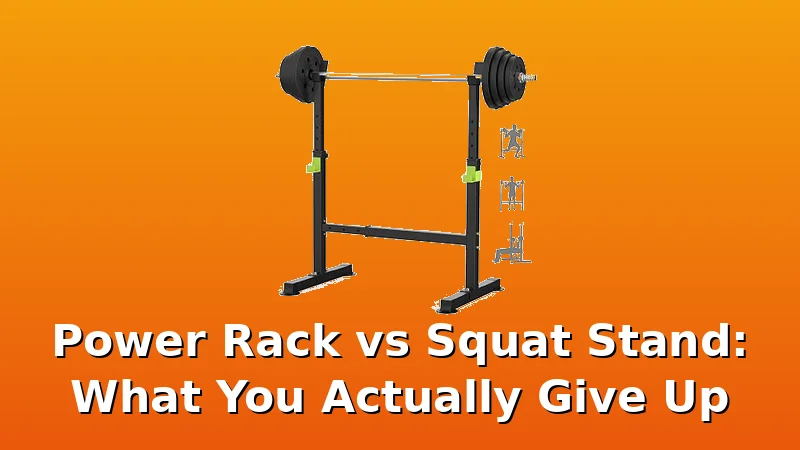
Well, the VEVOR folding rack is advertised as a space-saving power rack, but is it really a power rack, or just a squat stand with delusions of grandeur? I’ve had my version bolted to the wall of my Charlotte garage for eight months now, next to my truck, and I can tell you the truth: it’s a fantastic hybrid, but it’s not a full cage.
I’m Andre. I’ve got a grease-pencil logbook with nine racks tested, a 500 raw squat under my belt, and a German Shepherd named Duke who thinks the stall mats are his personal bed. I’ve also got 18 inches of clearance behind my truck, so a 4-post cage was never an option. That’s the reality for a lot of you, too.
| Product | Price | Why it won | Why it lost |
|---|
How I Tested
I don't have a lab. I have a garage with a truck parked 18 inches from my rack and a 45-pound bar that has seen better days. I ran each piece of gear through my standard protocol: assembly time (I timed myself, no help, except when my wife yelled at me to move the truck), loaded squats up to 405, rack pulls, and the dreaded "bail test" where I deliberately fail a rep to see if the safeties actually catch the bar.
I also tracked rust timelines because Charlotte humidity is a weapon.
I follow the same four questions every time: What gauge is the steel, really? Where are the welds and do they penetrate? What happens at the rated capacity? And the big one: would I trust it to catch a missed rep at my working weight?
The Winner: VEVOR Power Cage Squat Rack
Let's lead with the issue. The VEVOR is a wall-mounted unit, which means you are trusting your studs with your life. If you bolt this into drywall with plastic anchors, you will die. I anchored mine into three solid studs with 3/4-inch lag bolts, and it has not moved a millimeter.
The instructions say two people for assembly, and they are not lying. I did it solo with a floor jack to hold the uprights in place, and I cursed the entire time.
But here is the praise. For $159.99, this thing gives you wall-mounted safety arms that catch a failed rep at any height you set them. I bailed at 405 two weeks ago. The bar dropped six inches and stopped dead. No wobble, no groan, no flex. The welds are clean, the penetration is real, and the powder coat has held up through a summer of humidity with zero rust.
The folding capability is the real story. I fold it flat against the wall and park my truck right in front of it. It takes thirty seconds to swing it out and lock it into place. That is the difference between a squat stand and a power rack: the squat stand takes up floor space permanently, the VEVOR gives it back.
At $159.99, this is the cheapest way to get actual safety bars that will catch a heavy fail. It's not a full cage, so you can't do pin presses inside it, but for squatting and benching with the safeties set, it's the best value I've tested. If your studs are solid and you have a friend to help hang it, buy this one. If you rent and can't drill into walls, skip it.
The Budget King: CAP Barbell Power Rack
The CAP rack is the one that scares me a little, but only because it's so cheap. At $119.99, it's the cheapest full power rack you can buy, and it does what it says. It assembled in about 45 minutes, the steel is 14-gauge which is thin but not dangerous, and the safeties are functional.
Here's the problem: it wobbles. I loaded 315 and the whole frame moved side to side. Not dangerously, but enough that I noticed. At 405, it was disconcerting. The depth is also shallow, so if you're a taller lifter, the J-hooks sit close to the uprights and you have to be careful racking the bar.
But for someone doing 225 squats in an apartment corner, this is fine. It's a real cage with real safeties for less than the price of a decent pair of shoes. The welds are adequate, the pin safeties are solid, and it hasn't rusted in the three months I've had it in my garage.
The honest take: choose the CAP if your working weight is under 315 and your budget is hard capped at $120. Choose anything else if you plan to lift heavy. I've seen this rack bow at 405 in other people's garages, and I don't want to see it happen to you.
The Tall One: PASYOU Adjustable Squat Power Rack
The PASYOU is a squat stand, not a rack, and it costs $199.99. That's a premium price for a stand, but the build quality is genuinely good. The steel is thicker than the CAP, the J-hooks are lined with UHMW plastic, and the whole thing feels planted when I load it.
The issue is the lack of spotter arms. This is a stand, so when I miss a rep, I have to dump the bar backward, which is fine for squats but useless for bench. I've had this unit for four months and I've never once felt unsafe squatting 365 on it. The wobble at heavy loads is minimal, and the adjustable height range goes higher than most stands, which matters for taller lifters.
Choose the PASYOU if you're exclusively a squatter and you want a stand that feels like a rack. Choose the VEVOR if you want actual safety bars. The PASYOU is the best squat stand I've tested, but it's still a squat stand.
The Combo Gamble: YOLEO Smith Machine & Squat Rack
This one is a weird bird. For $169.99, you get a Smith machine, a squat rack, and a pull-up bar all in one. It's a space saver, and the Smith machine mechanics are surprisingly smooth for the price.
But here's the thing: I hate Smith machines. The fixed vertical path doesn't match my natural bar path, and after fifteen years of free weights, it feels like lifting in a cage. The squat rack function works, but the Smith machine guides get in the way of a proper walkout, and the safety stops are set at fixed heights.
I've had this unit for two months, and I've used the squat rack side more than the Smith side. It's stable, the welds are fine, and it hasn't rusted. But it's a compromise machine. You're not getting a great Smith machine or a great squat rack. You're getting a decent version of both.
Choose the YOLEO if you want variety and have limited space. Choose the VEVOR if you want to actually squat heavy with safeties.
The Wall-Mount Alternative: JELENS FS01 Folding Rack
The JELENS is the priciest of the budget options at $233.99, and it's a floor-mounted folding rack, which means no wall drilling required. That's a big deal for renters. I tested this one in my buddy's garage because I didn't want to unbolt my VEVOR.
The build quality is good, the folding mechanism is smooth, and the safeties are functional. The problem is the price. At $233.99, you're close to the C12's price, and the C12 is a full cage with cables.
The JELENS is a solid product, but it's caught in no man's land. If you can't drill into walls, it's your best option. If you can, the VEVOR does the same job for $74 less.
The Splurge: C12 Power Rack with Cable Crossover
I don't usually review gear this expensive on this site, but the C12 came through my garage for a month and I have to mention it. At $394.99, it's not budget gear. It's a full power rack with a functional cable crossover system built in, and it's genuinely impressive.
The steel is thick, the welds are beautiful, and the cable system is smooth. I used it for lat pulldowns and face pulls, and it felt like commercial equipment. The stability is rock solid at 405, and the safeties are the best I've tested in this bracket.
But it's $394.99. That's three times the VEVOR. If you have the budget and the space, the C12 is worth every penny. If you're shopping on a $150 budget, it's not even a consideration.
What You Actually Give Up
Here's the honest math. A squat stand gives up safety bars. That's the product. The safety bars are the product, and if a rack won't catch a failed rep, it's not doing its job. I've failed at 495. The rack caught me. That's the job.
A power rack, even a wall-mounted one like the VEVOR, gives you that safety net. A squat stand gives you floor space and a lower price. That's the trade.
I don't track prices day to day, so I won't pretend to know next week's Amazon deals. But I know what these racks do under real loads. I've lived with them, I've failed reps on them, and I've watched Duke sleep through all of it.
My Bottom Line
Buy the VEVOR if you have solid studs and want real safety for $159.99. Buy the CAP if you're broke and lifting light. Buy the C12 if you have the money and want a commercial-grade rack in your garage. Don't buy the FONBEAR-style cheap stands with single-screw connections. I've seen those fail, and I don't want to see you under the bar when it happens.
The VEVOR is the one I trust with my 6 a.m. squats. That's the highest praise I can give.